Match Insights
Quality Control
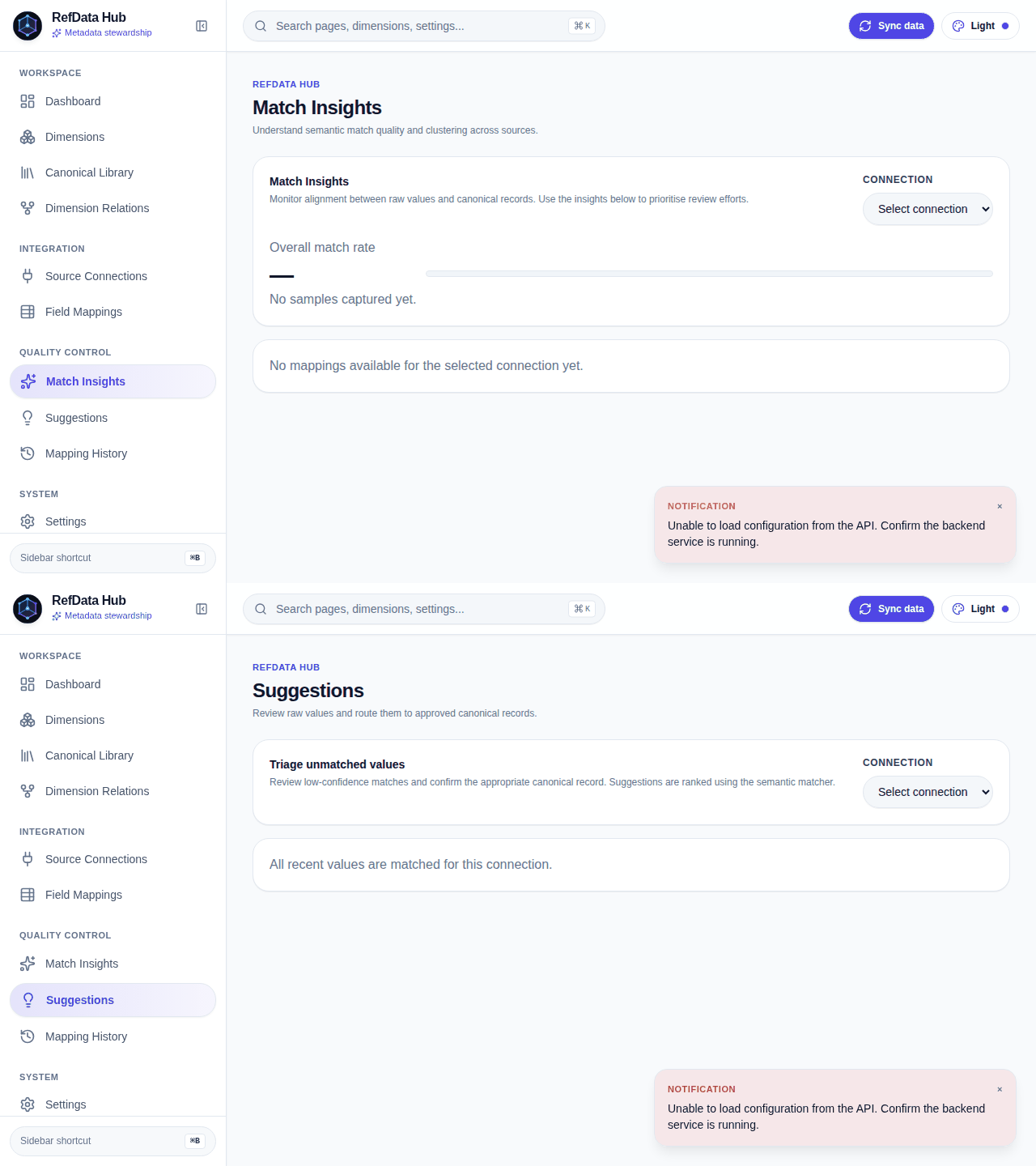
Match Insights answers one question: how much of my reference data is actually harmonized, and where is it failing? It reports coverage per field mapping, which is the unit you would realistically fix.
Reading the page
The page is driven by three API calls:
# 1. Connections, for the picker
curl http://localhost:8000/api/source/connections

# 2. Which columns are mapped, and therefore reportable
curl http://localhost:8000/api/source/connections

# 3. The statistics themselves
curl http://localhost:8000/api/source/connections/1/match-stats
Pick a connection and you get an overall match rate with a progress bar, then one card per mapped field.
FieldMatchStats
{
  "mapping_id": 7,
  "source_table": "employees",
  "source_field": "marital_status",
  "ref_dimension": "marital_status",
  "total_values": 3679,
  "matched_values": 3120,
  "unmatched_values": 559,
  "match_rate": 0.848,
  "top_unmatched": [
    {
      "raw_value": "M",
      "occurrence_count": 412,
      "suggestions": [
        {
          "canonical_id": 1,
          "canonical_label": "Married",
          "dimension": "marital_status",
          "score": 0.88
        }
      ]
    }
  ],
  "top_matched": [
    {
      "raw_value": "Married",
      "occurrence_count": 2890,
      "canonical_label": "Married",
      "match_type": "mapping",
      "confidence": 1.0
    }
  ]
}
Reading the numbers
| Field | Meaning |
|---|---|
total_values |
Distinct raw values captured for this column |
matched_values |
Distinct values with an approved mapping |
unmatched_values |
total_values − matched_values |
match_rate |
matched_values / total_values, between 0.0 and 1.0 |
match_rate is computed over distinct values, not row counts. A column of
3,679 rows with 12 distinct spellings can read 100% while still carrying a
messy source — use occurrence_count to judge the real blast radius.
match_type on matched values
| Value | Meaning |
|---|---|
mapping |
Resolved by an approved value mapping — deterministic, trust it |
semantic |
Resolved by embedding similarity — probabilistic, verify it |
A high rate dominated by semantic matches deserves more scrutiny than the same
rate driven by mapping rows.
Mappings created by hand appear here immediately
Cards refresh when mappings are created or edited, and when the global sync action runs. If a new mapping is not reflected, check that the write succeeded before assuming a caching problem.
No samples yet
Fields with no captured samples have nothing to report. Rather than showing a
misleading 0/0, Match Insights:
- falls back to configured field mappings when statistics are empty, so you can still see which columns are wired up and which are simply unpopulated
- keeps the cards visible so the gap is visible rather than hidden
A missing card is a data problem, not a bug
If a field you expect is absent, it has no samples. Go to Field Mappings and run capture against that mapping.
Using the numbers to prioritise
- Start with high-volume unmatched values. Sort
top_unmatchedbyoccurrence_count. One spelling covering 40% of a column beats forty spellings covering 1% each. - Check whether the canonical value exists. If it does, approve it. If it does not, you are finding a library gap, not a mapping gap.
- Watch for
semanticmatches on short raw values. A raw value ofMor1embeds poorly. These are the most likely source of silent mismatches. - Re-measure after each batch. Coverage is only meaningful as a trend.
Related
-
Suggestions
The actionable queue behind these numbers.
-
Mapping History
Audit what was approved, by whom, and when.