Reference Data Management & Harmonization
Enterprise reference data, harmonized.
RefData Hub solves reference data fragmentation across multi-system environments. Raw values — country codes, employment statuses, education levels, marital statuses — vary wildly between source databases, analytics pipelines, and third-party APIs. RefData Hub establishes a single source of truth:
- Ingest & profile raw values from upstream databases.
- Semantically match them to canonical dimensions using embedding vectors, with lexical fallback and optional LLM re-ranking.
- Route to reviewers who approve, reject, or refine suggestions in a purpose-built console.
- Publish canonical mappings to downstream warehouses, BI tools, and services.
-
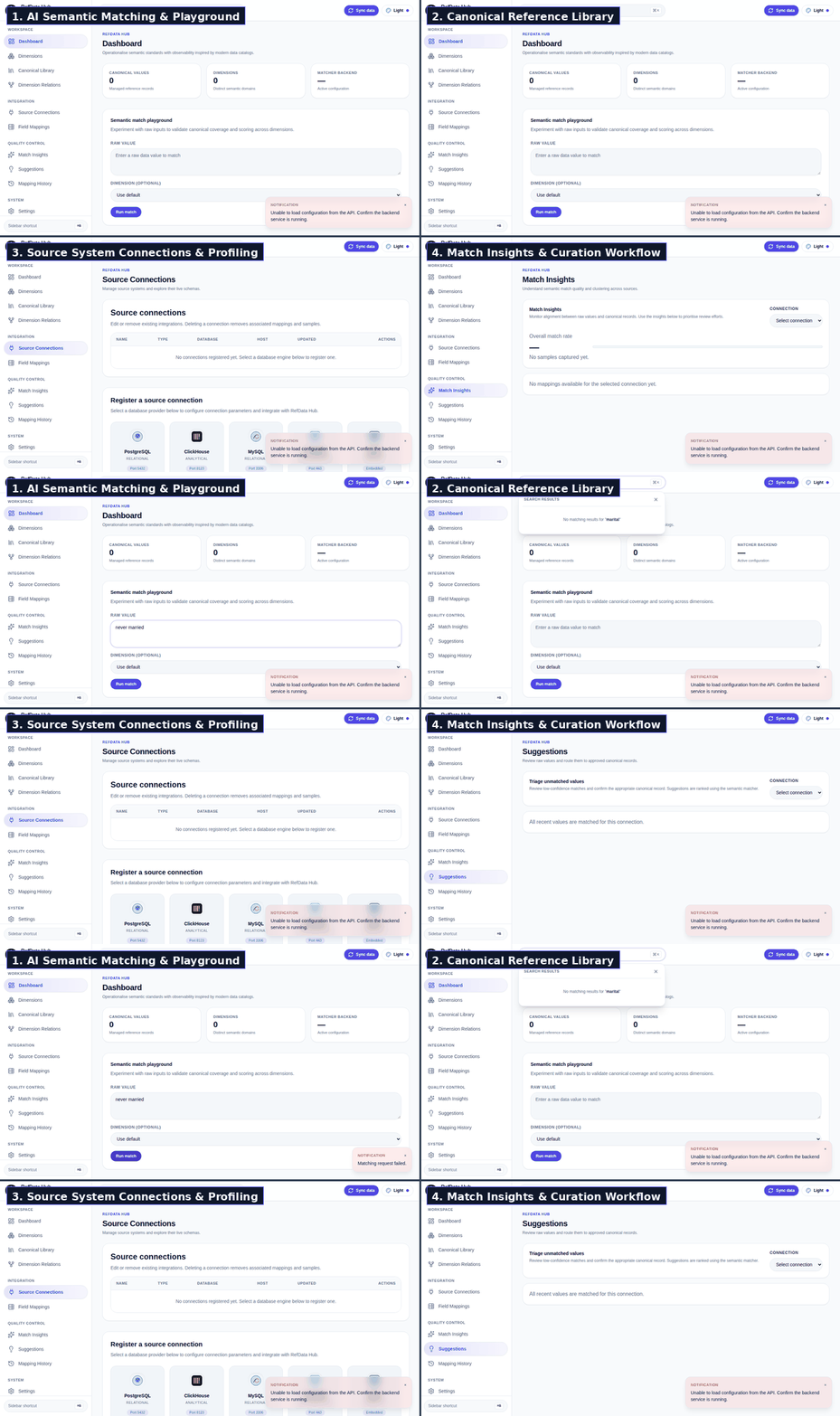
Dashboard
Metric tiles plus a semantic match playground for instant feedback on how the matcher is scoring your data.
-
Canonical Library
The approved golden records — labels, descriptions, and custom metadata attributes — that raw source values map into.
-
Semantic Matching
ONNX sentence-transformer embeddings ranked by cosine similarity, with a lexical fallback so the queue never goes empty.
-
Source Connections
Register upstream databases, test credentials inline, and introspect live schemas to drive mapping workflows.
-
Match Insights
Coverage rates, top matched and unmatched values, and mapping health per source field.
-
Mapping History
A full audit trail of every approved, corrected, or reverted mapping, with CSV and XLSX round-trip.
Quick start
That starts PostgreSQL with seeded reference data, the FastAPI backend, and the React reviewer UI:
| Service | URL |
|---|---|
| Reviewer UI | http://localhost:5274 |
| API | http://localhost:8000 |
| API docs (Swagger) | http://localhost:8000/docs |
| PostgreSQL | localhost:5432 |
Demo warehouse (targetdb) |
localhost:5433 |
To add a local LLM runtime for offline re-ranking:
Follow the Quickstart Guide for local (non-Docker) setup, first-run configuration, and seeding details.
How it fits together
RefData Hub sits between source systems and downstream consumers, providing intelligent harmonization through semantic matching and human curation.
Where to go next
-
Get running
Docker and local setup, first-run walkthrough, and seeding.
-
Understand the system
Component design, data flow, and the matching pipeline in depth.
-
Integrate with it
48 REST endpoints across reference, source, config, and agent routers.
Tech stack
- Backend — FastAPI (Python) with SQLModel / PostgreSQL
- Frontend — React 18 + Vite + Tailwind CSS
- Matching — ONNX sentence-transformer embeddings (default
BAAI/bge-small-en-v1.5) + lexical fallback + OpenAI/Ollama LLM - Testing — Pytest (backend) + Vitest (frontend)
- Infrastructure — Docker Compose, GitHub Pages for this documentation
Use cases
- Data warehousing — harmonize reference data across source systems
- Data quality — detect and fix inconsistent reference values
- Analytics — enforce consistent dimensions across reporting layers
- Data migration — map legacy values onto new standards
- Compliance — maintain an auditable reference data mapping trail
Support
- Documentation — you are reading it; see the nav or the GitHub repository
- Issues — github.com/rezer-bleede/refdata-hub/issues
- License — MIT